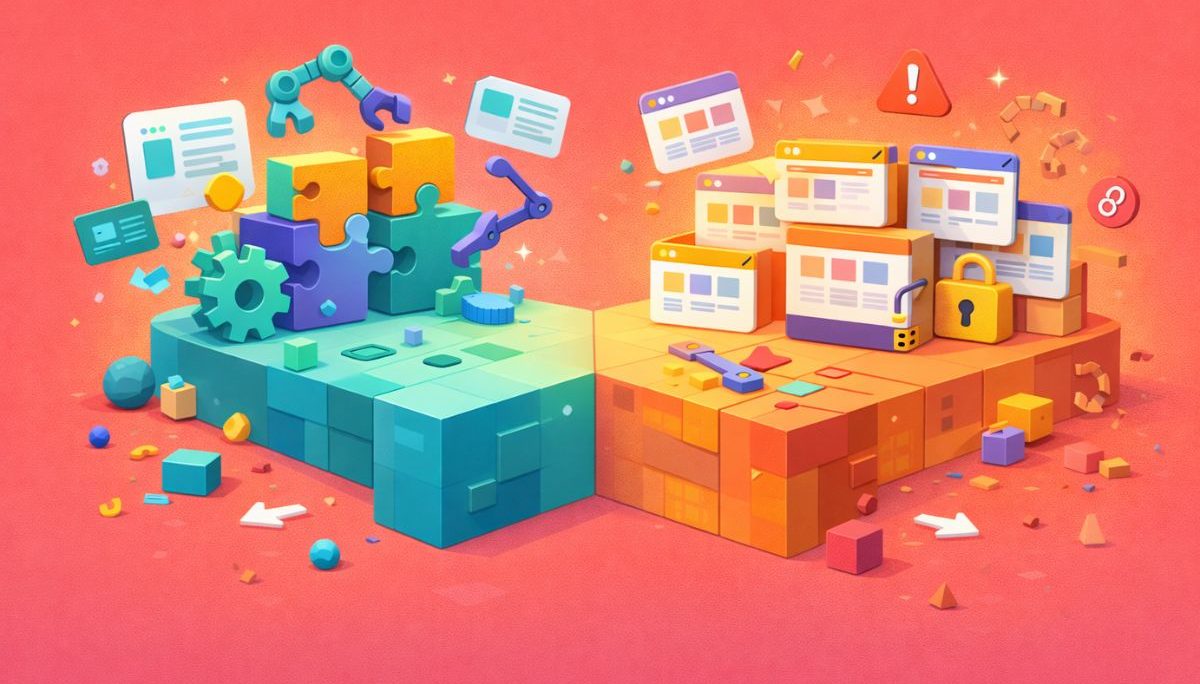
Custom software is a system built from scratch for a specific business. The development team studies your workflows, your data requirements, your compliance obligations, and your growth plans – then builds software that fits all of it precisely.
You own the source code. You control the feature roadmap. The system does exactly what your business needs and nothing you do not need.
Examples of custom software in Bangladesh include a tailored ERP for a garment manufacturer with production tracking, compliance documentation, and buyer portal integration that no generic ERP offers.
Or a logistics management platform for a distribution company with route-specific delivery scheduling, courier API connections, and warehouse inventory sync. Or a hospital management system with DGHS reporting requirements built directly into the clinical workflow.
The defining characteristic of custom software is that the starting point is always your business process – not a vendor’s feature list.
Off-the-shelf software (also called commercial off-the-shelf, COTS, or ready-made software) is a pre-built product designed to serve a wide range of businesses.
You purchase a license or subscribe to a plan and start using it immediately. The vendor handles updates, security patches, and new feature development. Your business adapts its processes to fit the software, not the other way around.
Common examples include Zoho for CRM, QuickBooks for accounting, Shopify for e-commerce, Slack for team communication, and Microsoft 365 for productivity. In Bangladesh, off-the-shelf options also include local SaaS products built specifically for this market – products like Biznify for SME accounting and ERP, ISP Digital for ISP management and billing, and Edufy for school and madrasa management.
The defining characteristic of off-the-shelf software is speed to deploy and lower upfront cost – but with the tradeoff that the software was not designed around your specific operations.
The table below compares both options across the ten factors that matter most to businesses in Bangladesh. No factor is weighted equally for every business – your priority ordering determines which option wins for your specific situation.
| Factor | Custom Software | Off-the-Shelf Software | Best For |
|---|---|---|---|
| Upfront Cost | Higher – typically BDT 3-80 lakh+ depending on scope | Lower – monthly or annual subscription, often BDT 2,000-50,000/month | Off-the-shelf wins if budget is the primary constraint |
| Long-Term Cost (3-5 years) | Predictable – you own it, no per-user fees that scale with growth | Accumulates – subscription fees, per-user charges, add-on costs, and price increases compound | Custom wins for growing businesses with 20+ users |
| Time to Launch | Months – typically 3-9 months depending on complexity | Days to weeks – sign up and start using immediately | Off-the-shelf wins when speed is critical |
| Fit to Your Workflow | Perfect – built around how your business actually operates | Partial – you adapt your process to fit the software’s assumptions | Custom wins for unique or complex operations |
| Bangladesh Compliance | Built in from day one – VAT Mushak 6.3, NBR, BTRC, Bangladesh Bank rules | Global tools: not supported. Local SaaS: supported natively | Custom or local SaaS wins |
| Payment Integration | Any gateway – bKash, Nagad, SSLCommerz, custom payment flows | Global tools: Stripe/PayPal only. Local SaaS: bKash/Nagad built in | Custom or local SaaS wins for Bangladesh |
| Scalability | Unlimited – you control the architecture | Limited by vendor plan tiers and feature gates | Custom wins for high-growth businesses |
| Ownership and Control | You own the source code, data, and feature roadmap | Vendor owns the software – you license access | Custom wins for IP-sensitive businesses |
| Maintenance | Your responsibility – need a support partner or internal team | Vendor handles updates, patches, and infrastructure | Off-the-shelf wins for teams without technical staff |
| Competitive Advantage | High – your software is unique to your business | None – every competitor can buy the same tool | Custom wins if differentiation matters |
A 2025 MuleSoft benchmark found that the average business runs 897 applications but only 29% are integrated. The cost of disconnected off-the-shelf tools – manual data entry, duplicated records, reporting workarounds, reconciliation errors – often exceeds the subscription fees themselves. Factor this “integration tax” into your total cost comparison.
The custom vs off-the-shelf debate is often framed as a binary. But there is a third option that matters particularly for Bangladesh businesses: local SaaS products built specifically for your industry and your market.
These products are technically off-the-shelf – pre-built, subscription-based, and used by many businesses. But they are designed from the ground up for Bangladesh’s regulatory environment, payment ecosystem, and industry-specific workflows. They combine the speed and cost advantage of off-the-shelf with the local compliance fit of custom software.
No existing product – local or global – handles your specific workflow. Your operations require a system built from scratch around proprietary business logic, unusual data relationships, or regulatory requirements specific to your niche.
ISP billing, school management, SME accounting, e-commerce operations – these follow recognisable patterns. A local SaaS product that already handles these workflows is faster, cheaper, and less risky than building from scratch.
Softifybd Ltd operates in this third category. We build subscription-based SaaS products designed for specific industries in Bangladesh – ISP Digital for internet service providers (1,300+ ISPs use it), Biznify for SME accounting and ERP, Edufy for schools and madrasas (600+ institutions), GetCommerce for e-commerce businesses. Each product is built around the workflows and compliance rules that businesses in these industries actually use every day.
When a local SaaS product covers your need, it is almost always the right choice over both global off-the-shelf and full custom development. The question is whether one exists for your specific industry and workflow.
Use these five questions to determine which path fits your business. Answer honestly.
| Question | If Yes | If No |
|---|---|---|
| 1. Does your business process provide a competitive advantage that software could protect? | Custom software – protect what makes you different | Off-the-shelf or local SaaS |
| 2. Does a local SaaS product exist for your specific industry in Bangladesh? | Start with local SaaS – faster, cheaper, already compliant | Evaluate global off-the-shelf, then consider custom |
| 3. Can your team adapt to how the off-the-shelf product works, without major workarounds? | Off-the-shelf works | Custom software – forcing fit costs more than building right |
| 4. Is your budget above BDT 5 lakh and your timeline longer than 3 months? | Custom is financially viable | Off-the-shelf or local SaaS |
| 5. Do you need Bangladesh-specific compliance (Mushak 6.3, BTRC, bKash/Nagad)? | Custom or local SaaS – global tools will not cover this | Global off-the-shelf may work |
A mid-sized ISP in Sylhet with 2,000 subscribers needed billing automation, subscriber management, and BTRC compliance reporting. They evaluated custom development (quoted at BDT 15 lakh, 5-month timeline) and ISP Digital by Softifybd Ltd (subscription-based, live within 2 weeks). They chose ISP Digital because it already handled everything they needed at a fraction of the cost.
A multi-branch RMG exporter needed a production tracking system connecting factory floor data with buyer compliance portals, real-time shipment tracking, and a custom costing module. No existing product covered this combination. They commissioned custom development and received a system that became their operational backbone.
A growing retail chain in Dhaka used Biznify by Softifybd Ltd for accounting, inventory, and POS across 4 outlets. But they also needed a custom loyalty programme with gamification features. They kept Biznify for core operations and built a lightweight custom module connected via API. Total cost: roughly 30% of a fully custom ERP.
| Industry | Typical Need | Best Path |
|---|---|---|
| ISP and Telecom | Subscriber billing, connection management, compliance, payment collection | Local SaaS – ISP Digital covers this natively |
| Education | Admissions, fee collection, attendance, results, parent portal | Local SaaS – Edufy serves 600+ institutions |
| SME Retail and Wholesale | Accounting, inventory, POS, HR, payroll | Local SaaS – Biznify with Bangladesh compliance built in |
| E-Commerce | Store management, payment, delivery integration, inventory | Local SaaS – GetCommerce for standard stores |
| RMG and Manufacturing | Production tracking, buyer compliance, costing, supply chain | Custom – Softifybd Ltd custom development |
| Healthcare | Patient records, appointments, DGHS reporting, pharmacy | Custom or specialist product |
| Travel and Tourism | Booking management, supplier integration, payment, packages | Local SaaS – OTA Platform |
| Logistics and Fleet | Vehicle tracking, route management, delivery scheduling | Local SaaS or custom – depends on fleet size |
Softifybd Ltd builds both SaaS products and custom software. We can tell you honestly whether one of our existing products covers your need or whether custom development is the right investment. We have no incentive to push you toward the more expensive option if the simpler one works.
Not exactly, though the terms overlap. Off-the-shelf software is the broader category – any pre-built software for a general market. SaaS (Software as a Service) is the delivery model – you access the software via the internet and pay a subscription rather than buying a perpetual license.
In 2026, most off-the-shelf business software is delivered as SaaS. But some off-the-shelf software is still sold as a one-time purchase. And some custom software is also delivered as SaaS – where the software development company builds and hosts the system for you on a subscription basis.
The practical takeaway: when someone says “off-the-shelf,” they almost always mean SaaS in 2026. The distinction that matters more is whether the software was designed for your specific market (local SaaS) or designed for a global audience (global SaaS).
Many successful Bangladesh businesses use both. The practical strategy: use off-the-shelf for standard operations, and build custom only for the parts of your business where no existing tool fits.
This hybrid approach gives you speed where speed matters and precision where precision matters – without overbuilding or underinvesting.
This is one of the most consequential technology decisions a business in Bangladesh makes – and one of the most frequently made for the wrong reasons. Companies pick off-the-shelf tools because they are cheap and fast. Then they spend the next two years building workarounds, exporting data into spreadsheets, and paying for integrations that should have been standard. Other businesses invest in custom software when a simple subscription product would have covered 90% of what they needed.
Custom software is a system built from scratch for a specific business. The development team studies your workflows, your data requirements, your compliance obligations, and your growth plans – then builds software that fits all of it precisely.
You own the source code. You control the feature roadmap. The system does exactly what your business needs and nothing you do not need.
Examples of custom software in Bangladesh include a tailored ERP for a garment manufacturer with production tracking, compliance documentation, and buyer portal integration that no generic ERP offers.
Or a logistics management platform for a distribution company with route-specific delivery scheduling, courier API connections, and warehouse inventory sync. Or a hospital management system with DGHS reporting requirements built directly into the clinical workflow.
The defining characteristic of custom software is that the starting point is always your business process – not a vendor’s feature list.
Off-the-shelf software (also called commercial off-the-shelf, COTS, or ready-made software) is a pre-built product designed to serve a wide range of businesses.
You purchase a license or subscribe to a plan and start using it immediately. The vendor handles updates, security patches, and new feature development. Your business adapts its processes to fit the software, not the other way around.
Common examples include Zoho for CRM, QuickBooks for accounting, Shopify for e-commerce, Slack for team communication, and Microsoft 365 for productivity. In Bangladesh, off-the-shelf options also include local SaaS products built specifically for this market – products like Biznify for SME accounting and ERP, ISP Digital for ISP management and billing, and Edufy for school and madrasa management.
The defining characteristic of off-the-shelf software is speed to deploy and lower upfront cost – but with the tradeoff that the software was not designed around your specific operations.
The table below compares both options across the ten factors that matter most to businesses in Bangladesh. No factor is weighted equally for every business – your priority ordering determines which option wins for your specific situation.
| Factor | Custom Software | Off-the-Shelf Software | Best For |
|---|---|---|---|
| Upfront Cost | Higher – typically BDT 3-80 lakh+ depending on scope | Lower – monthly or annual subscription, often BDT 2,000-50,000/month | Off-the-shelf wins if budget is the primary constraint |
| Long-Term Cost (3-5 years) | Predictable – you own it, no per-user fees that scale with growth | Accumulates – subscription fees, per-user charges, add-on costs, and price increases compound | Custom wins for growing businesses with 20+ users |
| Time to Launch | Months – typically 3-9 months depending on complexity | Days to weeks – sign up and start using immediately | Off-the-shelf wins when speed is critical |
| Fit to Your Workflow | Perfect – built around how your business actually operates | Partial – you adapt your process to fit the software’s assumptions | Custom wins for unique or complex operations |
| Bangladesh Compliance | Built in from day one – VAT Mushak 6.3, NBR, BTRC, Bangladesh Bank rules | Global tools: not supported. Local SaaS: supported natively | Custom or local SaaS wins |
| Payment Integration | Any gateway – bKash, Nagad, SSLCommerz, custom payment flows | Global tools: Stripe/PayPal only. Local SaaS: bKash/Nagad built in | Custom or local SaaS wins for Bangladesh |
| Scalability | Unlimited – you control the architecture | Limited by vendor plan tiers and feature gates | Custom wins for high-growth businesses |
| Ownership and Control | You own the source code, data, and feature roadmap | Vendor owns the software – you license access | Custom wins for IP-sensitive businesses |
| Maintenance | Your responsibility – need a support partner or internal team | Vendor handles updates, patches, and infrastructure | Off-the-shelf wins for teams without technical staff |
| Competitive Advantage | High – your software is unique to your business | None – every competitor can buy the same tool | Custom wins if differentiation matters |
A 2025 MuleSoft benchmark found that the average business runs 897 applications but only 29% are integrated. The cost of disconnected off-the-shelf tools – manual data entry, duplicated records, reporting workarounds, reconciliation errors – often exceeds the subscription fees themselves. Factor this “integration tax” into your total cost comparison.
The custom vs off-the-shelf debate is often framed as a binary. But there is a third option that matters particularly for Bangladesh businesses: local SaaS products built specifically for your industry and your market.
These products are technically off-the-shelf – pre-built, subscription-based, and used by many businesses. But they are designed from the ground up for Bangladesh’s regulatory environment, payment ecosystem, and industry-specific workflows. They combine the speed and cost advantage of off-the-shelf with the local compliance fit of custom software.
No existing product – local or global – handles your specific workflow. Your operations require a system built from scratch around proprietary business logic, unusual data relationships, or regulatory requirements specific to your niche.
ISP billing, school management, SME accounting, e-commerce operations – these follow recognisable patterns. A local SaaS product that already handles these workflows is faster, cheaper, and less risky than building from scratch.
Softifybd Ltd operates in this third category. We build subscription-based SaaS products designed for specific industries in Bangladesh – ISP Digital for internet service providers (1,300+ ISPs use it), Biznify for SME accounting and ERP, Edufy for schools and madrasas (600+ institutions), GetCommerce for e-commerce businesses. Each product is built around the workflows and compliance rules that businesses in these industries actually use every day.
When a local SaaS product covers your need, it is almost always the right choice over both global off-the-shelf and full custom development. The question is whether one exists for your specific industry and workflow.
Use these five questions to determine which path fits your business. Answer honestly.
| Question | If Yes | If No |
|---|---|---|
| 1. Does your business process provide a competitive advantage that software could protect? | Custom software – protect what makes you different | Off-the-shelf or local SaaS |
| 2. Does a local SaaS product exist for your specific industry in Bangladesh? | Start with local SaaS – faster, cheaper, already compliant | Evaluate global off-the-shelf, then consider custom |
| 3. Can your team adapt to how the off-the-shelf product works, without major workarounds? | Off-the-shelf works | Custom software – forcing fit costs more than building right |
| 4. Is your budget above BDT 5 lakh and your timeline longer than 3 months? | Custom is financially viable | Off-the-shelf or local SaaS |
| 5. Do you need Bangladesh-specific compliance (Mushak 6.3, BTRC, bKash/Nagad)? | Custom or local SaaS – global tools will not cover this | Global off-the-shelf may work |
A mid-sized ISP in Sylhet with 2,000 subscribers needed billing automation, subscriber management, and BTRC compliance reporting. They evaluated custom development (quoted at BDT 15 lakh, 5-month timeline) and ISP Digital by Softifybd Ltd (subscription-based, live within 2 weeks). They chose ISP Digital because it already handled everything they needed at a fraction of the cost.
A multi-branch RMG exporter needed a production tracking system connecting factory floor data with buyer compliance portals, real-time shipment tracking, and a custom costing module. No existing product covered this combination. They commissioned custom development and received a system that became their operational backbone.
A growing retail chain in Dhaka used Biznify by Softifybd Ltd for accounting, inventory, and POS across 4 outlets. But they also needed a custom loyalty programme with gamification features. They kept Biznify for core operations and built a lightweight custom module connected via API. Total cost: roughly 30% of a fully custom ERP.
| Industry | Typical Need | Best Path |
|---|---|---|
| ISP and Telecom | Subscriber billing, connection management, compliance, payment collection | Local SaaS – ISP Digital covers this natively |
| Education | Admissions, fee collection, attendance, results, parent portal | Local SaaS – Edufy serves 600+ institutions |
| SME Retail and Wholesale | Accounting, inventory, POS, HR, payroll | Local SaaS – Biznify with Bangladesh compliance built in |
| E-Commerce | Store management, payment, delivery integration, inventory | Local SaaS – GetCommerce for standard stores |
| RMG and Manufacturing | Production tracking, buyer compliance, costing, supply chain | Custom – Softifybd Ltd custom development |
| Healthcare | Patient records, appointments, DGHS reporting, pharmacy | Custom or specialist product |
| Travel and Tourism | Booking management, supplier integration, payment, packages | Local SaaS – OTA Platform |
| Logistics and Fleet | Vehicle tracking, route management, delivery scheduling | Local SaaS or custom – depends on fleet size |
Softifybd Ltd builds both SaaS products and custom software. We can tell you honestly whether one of our existing products covers your need or whether custom development is the right investment. We have no incentive to push you toward the more expensive option if the simpler one works.
Not exactly, though the terms overlap. Off-the-shelf software is the broader category – any pre-built software for a general market. SaaS (Software as a Service) is the delivery model – you access the software via the internet and pay a subscription rather than buying a perpetual license.
In 2026, most off-the-shelf business software is delivered as SaaS. But some off-the-shelf software is still sold as a one-time purchase. And some custom software is also delivered as SaaS – where the software development company builds and hosts the system for you on a subscription basis.
The practical takeaway: when someone says “off-the-shelf,” they almost always mean SaaS in 2026. The distinction that matters more is whether the software was designed for your specific market (local SaaS) or designed for a global audience (global SaaS).
Many successful Bangladesh businesses use both. The practical strategy: use off-the-shelf for standard operations, and build custom only for the parts of your business where no existing tool fits.
This hybrid approach gives you speed where speed matters and precision where precision matters – without overbuilding or underinvesting.
Custom software is built for one business around its exact workflows. Off-the-shelf software is a pre-built product for a broad market. Custom offers perfect fit and full ownership but costs more upfront. Off-the-shelf is faster and cheaper but may force workarounds if your process does not match. For Bangladesh businesses, local SaaS products offer a middle ground - pre-built products designed specifically for this market.
Global examples: Zoho (CRM), QuickBooks (accounting), Shopify (e-commerce), Microsoft 365 (productivity). Bangladesh-specific examples: ISP Digital (ISP management), Biznify (SME ERP), Edufy (school management) - all by Softifybd Ltd, designed for the Bangladesh market.
Limited fit to unique workflows, vendor dependency (vendor controls roadmap and pricing), integration challenges, accumulated subscription costs, and compliance gaps for Bangladesh businesses. Most global tools do not support VAT Mushak 6.3 or bKash/Nagad payment.
They overlap but are not identical. Off-the-shelf is any pre-built product for a general market. SaaS is the delivery model (internet access, subscription pricing). In 2026, most off-the-shelf business software is SaaS. The more useful distinction is whether it was designed for your specific market (local SaaS) or a global audience.
Typically $3,000 to $100,000+ depending on scope. Simple mobile app: $8,000-$25,000. Mid-complexity ERP: $25,000-$80,000. Enterprise platforms: $80,000+. For standard industry needs, Softifybd Ltd's subscription products like Biznify and ISP Digital offer much lower monthly costs.
Choose local SaaS if a proven product exists for your industry with Bangladesh compliance built in. Choose custom if your process is unique and no product covers 50%+ of your needs. Many businesses use a hybrid approach. Read our industry overview for more context on the landscape.